How to choose the slewing ring pinion?
March 6, 2023What are slewing bearings for wind turbines?
March 23, 2023
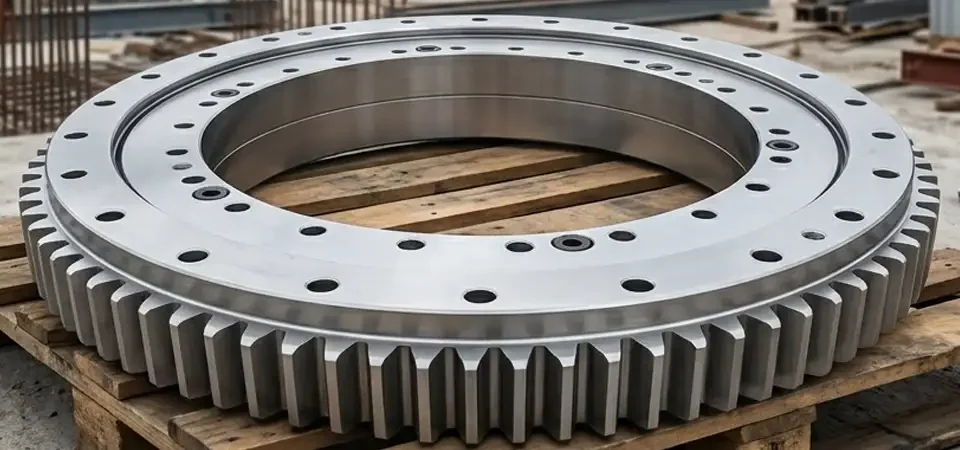
The slewing bearing is a key structural part of a series of construction machinery such as pile extractors, pile drivers, and excavators. It is a force-transmitting element that keeps the upper body and the lower body in relative rotary motion, and is used to support the mass of the upper body and bear the working load. The inner race is connected to the lower car body, the outer race is connected to the upper car body, and the inner ring gear on the inner race is meshed with the pinion of the rotary motor. When the rotary motor rotates, the upper car body is driven to rotate by the pinion. The slewing bearing of the pile extractor uses an internal tooth slewing bearing. Because of the impact load, the tooth surface and raceway are generally quenched.

There are two types of failure of slewing bearings, one is raceway damage, and the other is broken teeth. Quenching is an important process for slewing bearings to improve load performance. After the workpiece is heated and kept warm, it is rapidly cooled in quenching media such as water, oil or other inorganic salts and organic aqueous solutions. For example, when the part is subjected to alternating loads such as torsion and bending, and impact loads, its surface layer bears higher stress than the core. In the case of friction, the surface layer is continuously worn, resulting in broken teeth. Different heat treatment methods can improve the overall performance of the bearing and reduce the failure rate.
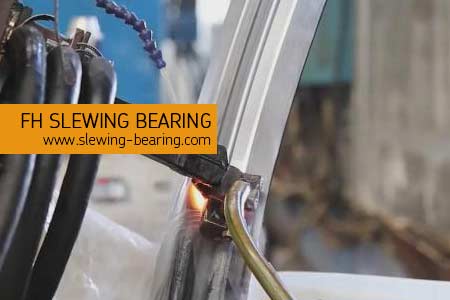
The quenching process and quenching quality are very important. The existing quenching process is simple, which easily leads to small cracks on the quenching raceway surface, and seriously causes the workpiece to be scrapped. In this regard, in the process of applying the quenching process to the slewing bearing, it is necessary to check the material, geometric size and roughness (machining accuracy) of the raceway, the linear speed and runout of the raceway rotation, the shape of the sensor and the position of the workpiece, and the heating temperature , Quenching liquid selection, control, pressure and other factors are strictly controlled, among which the main factors are raceway quenching hardness, hardened layer depth, raceway curvature radius and contact angle.