Slewing Bearing Housing Design: The Secret to Bearing Longevity
April 7, 2026
What Is a Slewing Bearing?
April 14, 2026
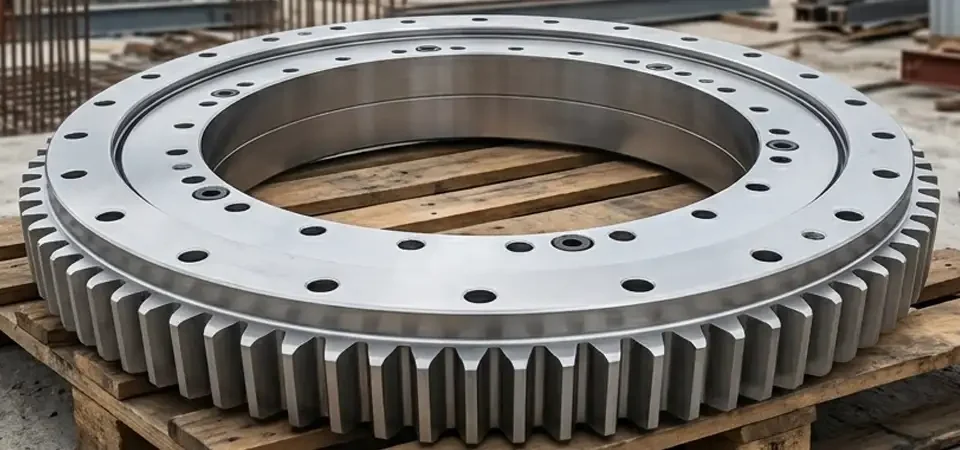
If you look closely at a new slewing ring before installation, you will likely notice a small stamped “S” on the face of both the inner and outer rings. For a component designed to handle hundreds of tons of force, this little letter is incredibly important.
That “S” indicates the location of the slewing bearing soft zone.
Ignoring this mark during installation is one of the leading causes of premature bearing failure. In this guide, we will explain exactly what the soft zone is, why manufacturers have to include it, and the golden rules for positioning it correctly.
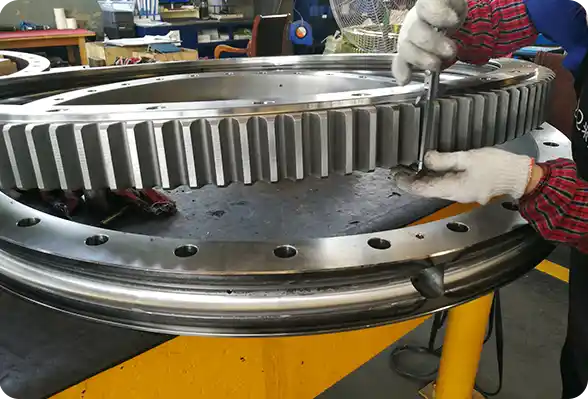
What is a Slewing Bearing Soft Zone?
To handle massive loads without wearing out, the raceways of a slewing bearing (the tracks where the balls or rollers run) must be hardened. Manufacturers achieve this using a process called induction hardening, where a heating coil travels along the circular raceway to harden the steel.
However, when the heating coil completes the 360-degree circle and meets its starting point, the hardened areas cannot perfectly overlap. If they did, the overlapping section would become dangerously brittle and prone to cracking under pressure.
To prevent this, the manufacturer leaves a small, unhardened gap between the start and end points of the heating process. This unhardened section is the slewing bearing soft zone.
Note: In many designs, this soft zone is also the exact location of the insertion hole (or plug hole) where the rolling elements are loaded into the bearing during assembly.
Why Does the Soft Zone Matter?
Because it hasn’t been hardened, the soft zone is the weakest point on the entire slewing ring.
If this area is subjected to maximum load—such as the heavy tipping moment of a loaded crane boom or an excavator bucket digging into rock—the soft metal will deform. Once the raceway deforms, the rolling elements will catch or grind as they pass over it. This leads to:
Spalling: Metal flaking off the raceway.
Jammed Rotation: The bearing will feel “rough” or get stuck.
Catastrophic Failure: The bearing will destroy itself rapidly, leading to massive downtime and safety hazards.
Golden Rules for Installing the Soft Zone
To ensure your machinery achieves its maximum lifespan, you must position the soft zone strategically during installation. The goal is to place the “S” mark in the zero-load or minimum-load zone.
Here are the standard engineering best practices for positioning:
1. Locate the Minimum Load Axis
In heavy machinery (like excavators or cranes), the maximum load is always along the primary working axis (the boom or the arm). Therefore, the soft zone should be placed perpendicular (at a 90-degree angle) to the primary load axis. It should never be in the direct line of the heaviest lifting or digging forces.
2. Stagger the “S” Marks
You have two soft zones: one on the inner ring and one on the outer ring. Never align them with each other. You should always stagger the “S” marks by 180 degrees. If the outer ring’s soft zone is at the 12 o’clock position, the inner ring’s soft zone must be placed at the 6 o’clock position.
3. Check the Plug Location
If the “S” mark has faded or you are dealing with an older bearing, look for the taper pin or the plug hole on the outer ring. The plug is almost always located exactly at the soft zone.
Final Thoughts
The slewing bearing soft zone is a necessary byproduct of the manufacturing process, but it doesn’t have to be a weak link in your machinery. By simply understanding what the “S” mark means and following proper positioning protocols during installation, you can prevent uneven wear, save thousands of dollars in replacement costs, and keep your equipment running smoothly.