Slewing Ring Drive with Gearbox & Electric Motor
May 15, 2026
Customized Crane Slewing Ring: Engineering the Perfect Fit
June 23, 2026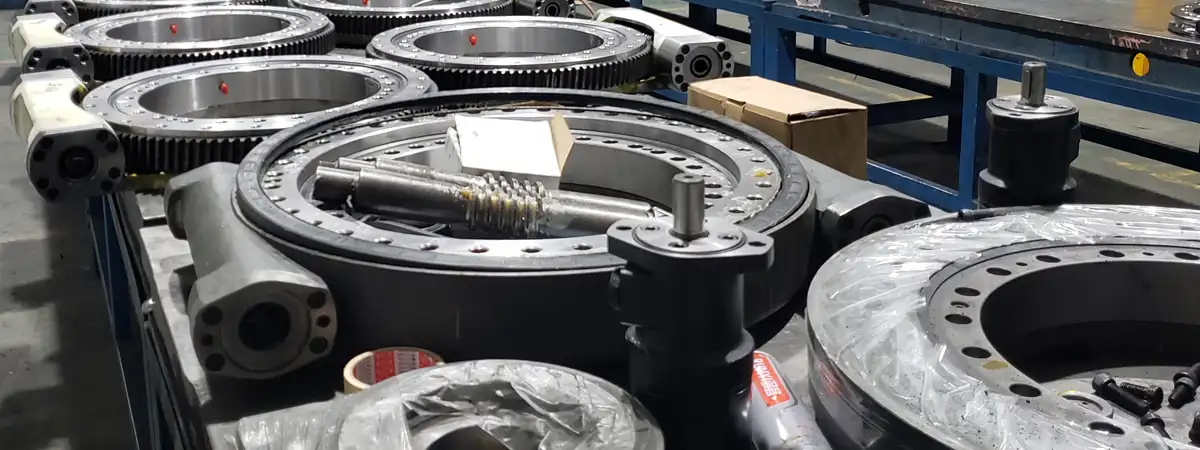
Slewing Ring with Worm Gear: Mechanics, Advantages, and Applications
When engineering rotational machinery, you generally need two things: a heavy-duty bearing to support the weight and a drive mechanism to rotate it. What if you could combine both into one compact, highly efficient unit?
That is exactly what a slewing ring with worm gear achieves.
Often referred to in the industry as a "slewing drive," this integrated system is a game-changer for engineers who need high-torque rotation in tight spaces. In this guide, we will break down how a slewing ring with worm gear works, its unique mechanical advantages, and where it is most commonly used in modern industry.
What is a Slewing Ring with Worm Gear?
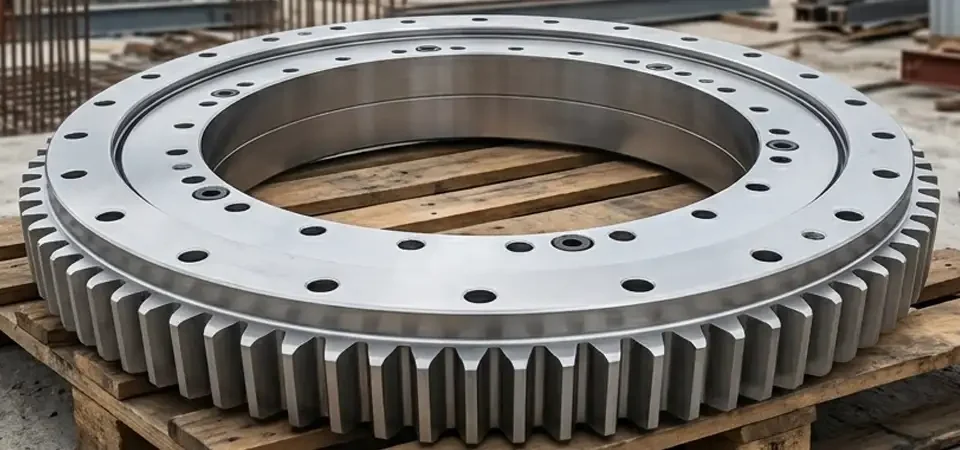
A standard slewing ring bearing usually has spur gear teeth cut into its inner or outer ring, requiring an external pinion gear and motor to drive it.
A slewing ring with worm gear alters this design completely. Instead of standard spur teeth, the outer edge of the slewing ring is machined with worm wheel teeth. A threaded cylindrical shaft (the worm) is meshed tangentially against these teeth. When a motor turns the worm shaft, the threads push against the teeth of the ring, causing the entire bearing to rotate slowly and precisely.
Because the components are matched perfectly at the factory, a worm gear slewing ring bearing offers a highly integrated, plug-and-play rotational solution.
The Biggest Advantage: The Self-Locking Feature
The most significant engineering benefit of utilizing a worm gear mechanism is its inherent safety feature known as static self-locking.
In standard gear systems, if a heavy wind pushes against the rotating equipment, the force can back-drive the gears, causing the motor to spin backward and the machine to lose its position.
However, because of the friction and the steep angle of the worm threads, the gear can only be driven by the worm shaft. The ring itself cannot push the worm backward. This creates a self-locking slewing ring that holds its position rigidly without the need for complex, expensive external braking systems.
Enclosed Slewing Drives vs. Open Designs
When purchasing this type of setup, you generally have two design options depending on your operating environment:
1. Open Worm Gear Rings
The bearing and the worm shaft are exposed. This is highly cost-effective and makes maintenance (like greasing) incredibly easy. However, it should only be used in clean, indoor environments where dust and debris cannot jam the gear mesh.
2. Enclosed Slewing Drives
In this configuration, the entire slewing drive with worm gear is wrapped in a heavy-duty protective housing (often rated IP65 or higher). This housing is packed with grease and sealed shut with rubber O-rings.
The Benefit: It prevents sand, dirt, rain, and corrosive chemicals from destroying the gears. If your equipment operates outdoors, an enclosed slewing drive is an absolute necessity.
Top Industrial Applications
Because it offers high torque, low-speed precision, and self-locking capabilities, this mechanism is highly sought after across several key industries:
Renewable Energy: This is by far the largest market. A solar tracker slewing drive rotates massive arrays of solar panels to follow the sun precisely throughout the day, maximizing energy output while locking the panels in place against high winds.
Manlifts and Aerial Work Platforms: The self-locking safety feature ensures that the bucket holding the worker remains perfectly stable and will not swing unexpectedly.
Truck-Mounted Cranes: For lighter mobile cranes, the compact nature of the worm gear drive saves valuable space on the truck chassis compared to traditional bulky motor-and-pinion setups.
Industrial Automation: Used in rotating welding positioners and heavy-duty assembly line turntables where precise, controlled movement is required.
Conclusion
A slewing ring with worm gear simplifies heavy machinery design by merging load-bearing capabilities with a high-torque, self-braking power transmission system. By opting for this integrated design—especially an enclosed model for outdoor use—you can save engineering time, reduce installation space, and significantly lower the long-term maintenance costs of your equipment.
Are you deciding between a standard turntable bearing and a fully enclosed slewing drive for your next project? Always analyze your environmental hazards and back-driving risks to make the most cost-effective choice!