How Do I Select the Right Slewing Ring for My Machine?
July 7, 2026
The Ultimate Lazy Susan Bearing Size Chart: How to Choose the Right Hardware
July 30, 2026
Standard vs Custom Slewing Bearing: How to Decide
Skip the pros-and-cons debate for a second. The standard-vs-custom decision usually resolves itself once you answer a handful of specific questions about your project, in order. Work through the path below and you'll likely land on your answer before reaching the end.
Start Here: Does an Existing Standard Size Match Your Mounting Dimensions Exactly?
→ If yes, continue to the next question. → If no — your bore, outer diameter, or bolt pattern don't match any catalog size — you're already looking at custom. Trying to redesign your machine's mounting structure around a standard size is usually more expensive than just ordering a custom bearing in the first place.
Next: Does a Standard Bearing Meet Your Load Requirements With an Appropriate Margin?
→ If yes, continue to the next question. → If no — your calculated axial, radial, or moment loads exceed what any standard option in your size range can handle — custom is the answer. This is common in heavy equipment applications where load requirements are simply higher than what standard catalogs cover.
Next: Do You Need a Non-Standard Gear Configuration?
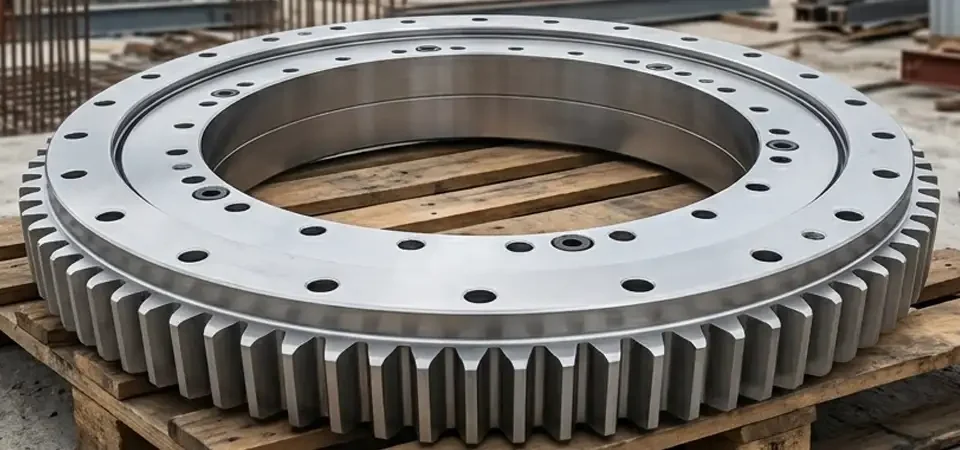
Standard bearings ship with common gear modules and tooth counts. If your drive system requires a specific gear spec to match an existing pinion or motor assembly, and no standard option matches it:
→ If your gear needs match a standard option, continue to the next question. → If they don't match, custom is the answer — even if the bearing's dimensions and load rating would otherwise fit a standard size.
Next: Does Your Application Involve an Unusual Operating Environment?
Standard bearings are built with general-purpose seals and grease suited to typical operating conditions. If your application involves:
- Marine or heavy corrosion exposure
- Extreme temperature ranges outside typical ratings
- Unusually high contamination levels (mining, heavy construction dust)
→ If your environment is fairly typical, continue to the final question. → If it's unusual, custom sealing, coating, or grease specification is likely needed — even if every other spec matches a standard bearing.
Final Question: How Much Lead Time Do You Have?
If you've reached this point and a standard bearing matches your dimensions, load rating, gear needs, and environment — standard is very likely your answer, and it'll typically ship faster and cost less than a custom order.
If you've been routed to "custom" anywhere along this path, the remaining question is really about lead time planning: custom slewing bearings generally require longer manufacturing lead times than standard stock, so this decision needs to happen early in your project timeline, not close to a build deadline.
Why This Order Matters
Notice the sequence: dimensions first, then load, then gear, then environment, then timeline. That order reflects how unforgiving each factor actually is. A dimension mismatch or load shortfall makes a standard bearing simply unusable — no amount of budget flexibility fixes that. Environment and lead time, by contrast, are real considerations, but they're the kind of trade-offs worth weighing only once you've confirmed the bearing can physically and mechanically do the job.
Myth: "The Cheapest Quote That Meets Spec Is the Smart Choice"
When two quotes both technically meet your stated load rating, the gap in price is usually explained by steel quality, heat treatment consistency, or manufacturing tolerance control — none of which show up on a basic spec sheet.
Check instead: Ask suppliers directly about steel grade, hardness testing, and quality control process, especially when comparing quotes that look surprisingly far apart for "the same" bearing.
The Short Version
Selecting the right slewing ring isn't about starting with a size and hoping it works — it's about starting with real load numbers, confirming the drive mechanism, accounting for the environment, and only then comparing quotes on equal footing. Skip the shortcuts above, and the selection process takes a bit longer — but the bearing lasts as long as it's supposed to.